

#49. What I've learned so far wearing my Oura Ring
pros, cons, takeaways, trends, insights and more.

I got an Oura ring as a 30th birthday present from my girlfriends and Chris, back in April. I get asked about it a lot, whether I like it, whether I think it’s worth it, the pros and the cons, etc. I’ve had it now for 10 months, which is enough data collected to have some opinions on it. Let’s get into it!
Oura focuses on 3 main categories: Readiness, Sleep and Activity. I’m going to break down each category for you, provide some personal metrics, and finish with my pros/cons and takeaways.

Readiness Score - what is it, how is it calculated, why does it matter?
How to improve your Readiness Score
Readiness Score as a crystal ball
Let’s pick favourites: Basal Body Temperature & Heart Rate Variability
Sleep Score - everything that goes into calculating and analyzing it
Activity Score - why I don’t consider Oura Ring to be a fitness tracker
My personal quarterly trends
Pros, cons & takeaways

Readiness Score
My Readiness Score is ultimately what I really like to pay attention to. It helps me understand not only how ready I am for the day but also the days ahead. It’s the most personalized score, taking into account my sleep patterns, my recent activity, and my body's stress signals (like temperature and heart rate variability). It provides a holistic picture of my health at that moment, and helps me identify if my body needs rest, or if I can go for it and push things a bit that day, because I’m well and rested.
The Readiness Score is a combination of 7 contributing scores:
Sleep from previous night
Sleep balance (average amount in last couple of weeks)
Previous day activity
Activity balance (average activity level from last couple weeks)
Resting heart rate
Heart rate variability
Body temperature
Respiratory rate
The last 4 contributors are all dedicated to identifying signs of body stress. Any variation from the norm can be a sign that your body may be stressed, ill, injured, or that you’re experiencing a shift in your health. These numbers can shift before you even feel anything in some cases (I have a couple examples!) Let’s take a closer look at these contributors:
Resting Heart Rate (RHR) is the number of times your heart beats per minute while at rest. A below-average resting heart rate is a signal of recovery.
Heart Rate Variability (HRV) is the variation between your heartbeats. HRV is linked to the autonomic nervous system, and is an indicator of your stress levels, recovery status, and general well-being. HRV may be lower after high-intensity exercise, a night out, or a stressful day.
Body Temperature is the change in your nighttime skin temperature from your average which can act as an early signal of illness or hormonal fluctuations. Body temperature readings significantly above or below your normal range will lower your Readiness Score.
Respiratory Rate is the number of breaths you take per minute while asleep. Respiratory rates may increase with illness or stress.
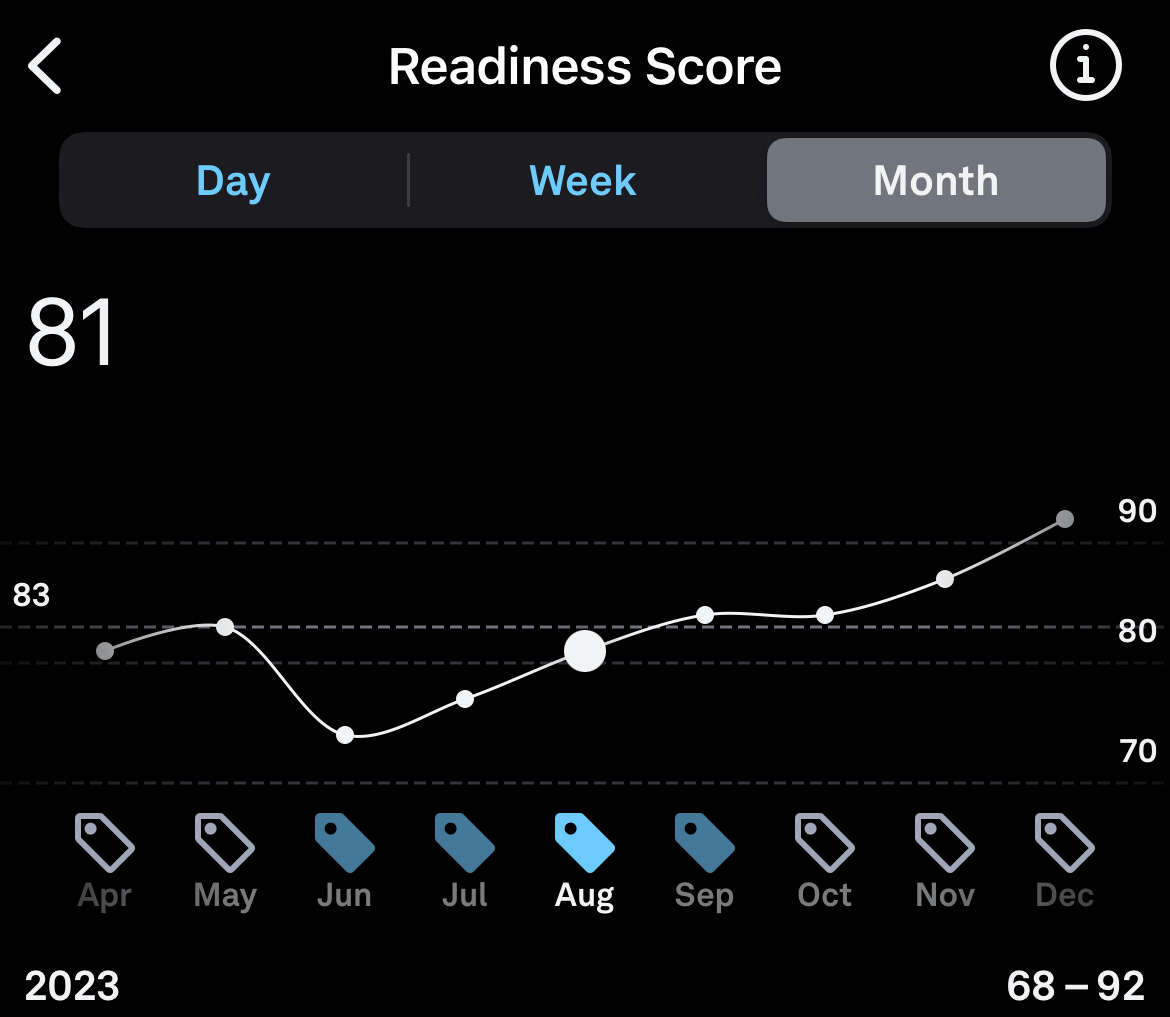
When we look at my average monthly Readiness Score above, you can clearly see a dip in the summer, and then a steady incline of improvement. I felt pretty burnt out this past summer. On top of working full time, I was teaching 3 - 4 strength classes a week, doing a bit of freelance content creation and whatever spare time I had in-between was filled with social obligations, hosting dinner parties, working out, or making extravagant weekend plans. It was a beautiful but busy time, and I don’t regret it, but it sure did take a tole on me. I find the trickiest part of saying ‘no’… the fact that, I don't actually want to say no. I WANT to do all these things. I want to connect, give, create, produce and push myself. But it comes at a cost.
So, how did I improved my Readiness Score so significantly?
Keep reading with a 7-day free trial
Subscribe to à la carte to keep reading this post and get 7 days of free access to the full post archives.